
Communities Facing Expulsion

Civil Administration demolishes 4 homes in Khallet Makhul, northern Jordan Valley, 18 months after demolishing all structures in community

At 6:30 A.M. on 18 March 2015, representatives of the Civil Administration arrived with a military escort at the shepherding community of Khallet Makhul in the northern Jordan Valley. Civil Administration bulldozers demolished four residential tents belonging to four of the community’s nine families. They also demolished 4 kitchens, 12 livestock enclosures and a tent used by one of the families to produce cheese. The very same day, the families erected tents they received from aid organizations to serve as substitute housing. The next evening, a military patrol arrived at the community. Once more, they demolished the tent of one of the families. The soldiers notified the three-person family, which now had no shelter, that should they erect another tent, the military would return and demolish it. The family has since erected another tent. Representatives of the Civil Administration or the military have not been back since.


Civil Administration bulldozers razing one cluster of tents. Photo: ‘Aref Daraghmeh, B’Tselem, 18 March 2015

The shepherding community of Khallet Makhul borders on the settlements of Hemdat to the south and Ro’i to the east. Khallet Makhul residents told B’Tselem there has been a Palestinian community there for over a century. Most of families of the current community arrived at the site in the 1960s and they lease the land from various owners – mostly members of the Daraghmeh family from Tubas. The present community has nine families, with a total population of 42, including 14 minors. They make their living primarily by raising flocks and rainwater-based farming on land close to the village. Khallet Makhul is not connected to a water network, nor is there any water source nearby that the residents can use. Consequently, they have no choice but purchase water from nearby villages and transport it home in tankers. In 2012, the Energy Research Center at An-Najah National University, Nablus, furnished the community with a solar energy system that supplies the residents with sufficient electricity to meet their needs.

This is not the first time that the authorities have demolished homes in Khallet Makhul. On 16 September 2013, Civil Administration representatives and soldiers demolished every structure in the village. Then, for several days, they prevented the residents from erecting alternative structures and confiscated tents and other equipment provided by aid organizations. The residents subsequently petitioned Israel’s High Court of Justice. The petition, filed by Att. Tawfiq Jabarin, sought the residents be allowed to rebuild and not have the rebuilt structures demolished. The petition was dismissed after the parties agreed that the residents apply to the Judea and Samaria planning committee for construction permits. The residents told B’Tselem that eight of the families filed applications and paid the attendant fees, and their applications are pending either in planning committees or in court. Three of the four structures demolished belong to families who had filed applications. Therefore, the Civil Administration, even according to its own regulations, has no authority to demolish them. On 24 March 2015 Att. Jabarin filed a renewed petition on behalf of the resident to the High Court of Justice, seeking that further demolitions in the community, including of the tents erected after the most recent demolition, be prevented. On the same day the petition was filed, the High Court of Justice issued an injunction that the State not carry out any further demolitions.
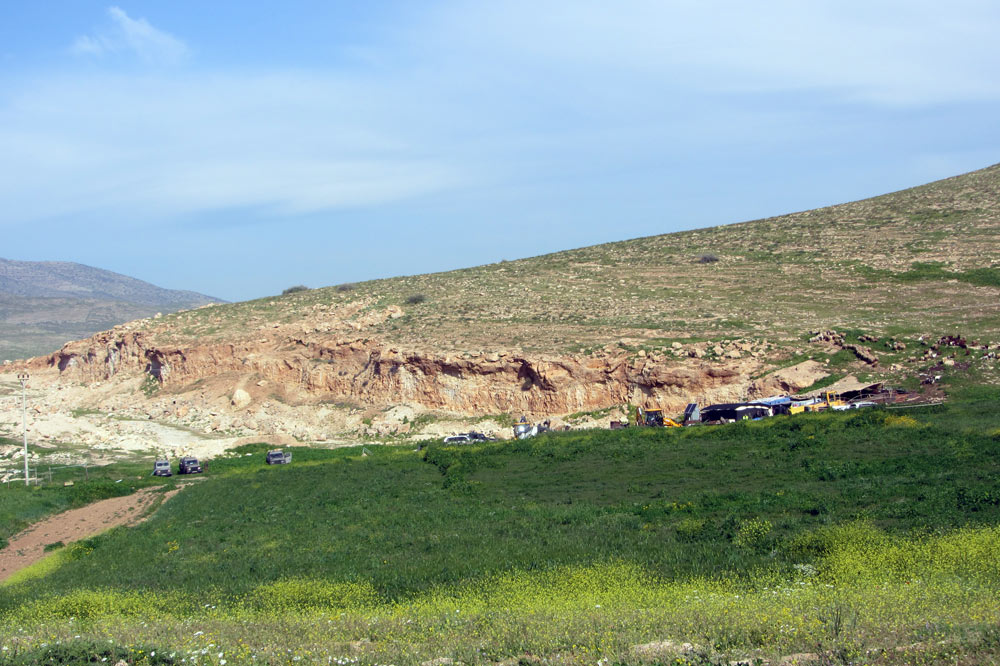
A tent cluster, before demolition. Photo: ‘Aref Daraghmeh, B’Tselem, 18 March 2015
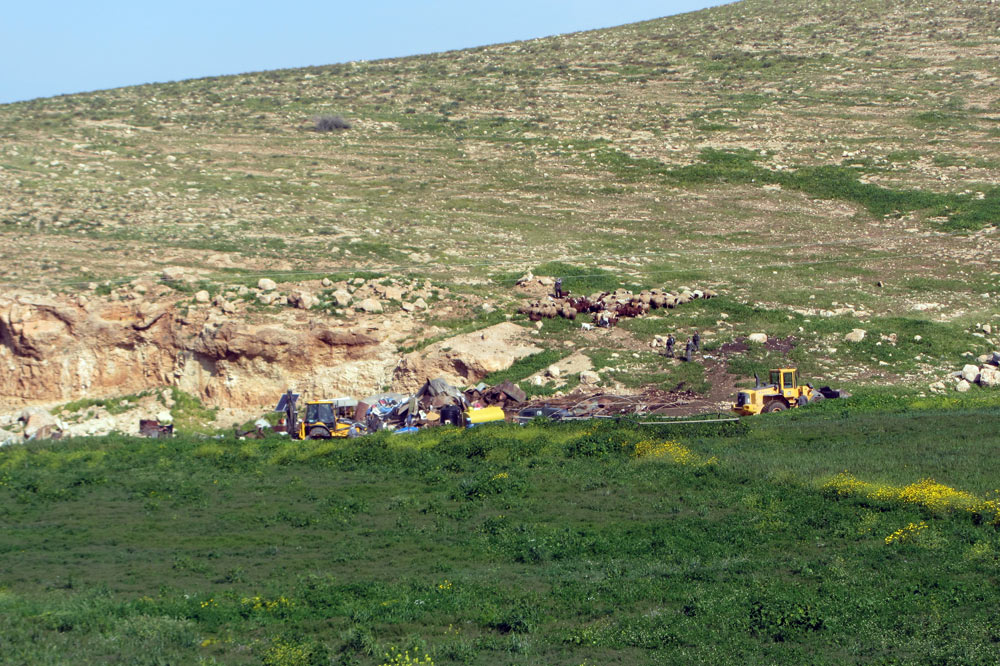
A tent cluster, before and after demolition. Photo: ‘Aref Daraghmeh, B’Tselem, 18 March 2015

A tent cluster after demolition. Photo: ‘Aref Daraghmeh, B’Tselem, 18 March 2015

The demolitions in Khallet Makhul are part of a long-standing policy by Israeli authorities to displace, citing a host of pretexts, thousands of Palestinians who live in dozens of small communities throughout Area C, the West Bank. At various times, Israeli officials have stated that they are interested in taking over Area C, and particularly the Jordan Valley, with a view to creating conditions that would make Israeli presence in the Jordan Valley a permanent fixture in the long run, even as part of a diplomatic agreement. Meanwhile, in practice, Israel is annexing Area C and taking action to minimize Palestinian presence there.

Israel, as the occupying force in the West Bank, must allow the local population to carry on with their lives. This obligation includes allowing them to build their homes legally, utilize water sources and preserve their way of life.

B’Tselem calls on the authorities responsible to allow the residents of Khallet Makhul to carry on living unmolested in their community, to tend their flocks as they have done for nearly fifty years, and allow them to develop their community and better their living conditions.
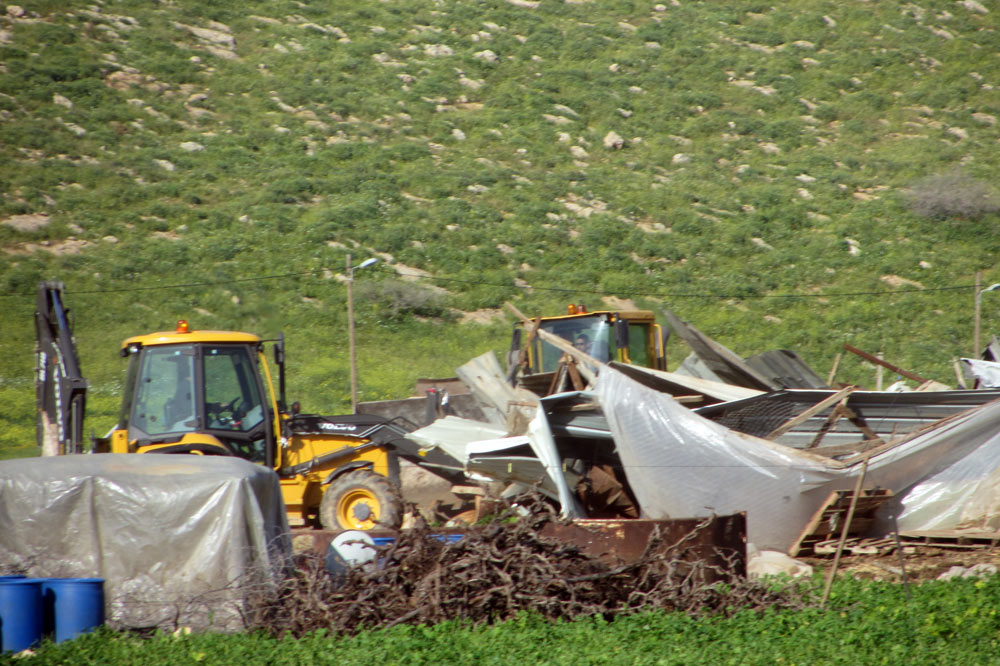
Civil Administration bulldozers in action. Photo: ‘Aref Daraghmeh, B’Tselem, 18 March 2015

Civil Administration bulldozer drives off, leaving a trail of destruction in its wake. Photo: ‘Aref Deraghmeh, B’Tselem, 18 March 2015
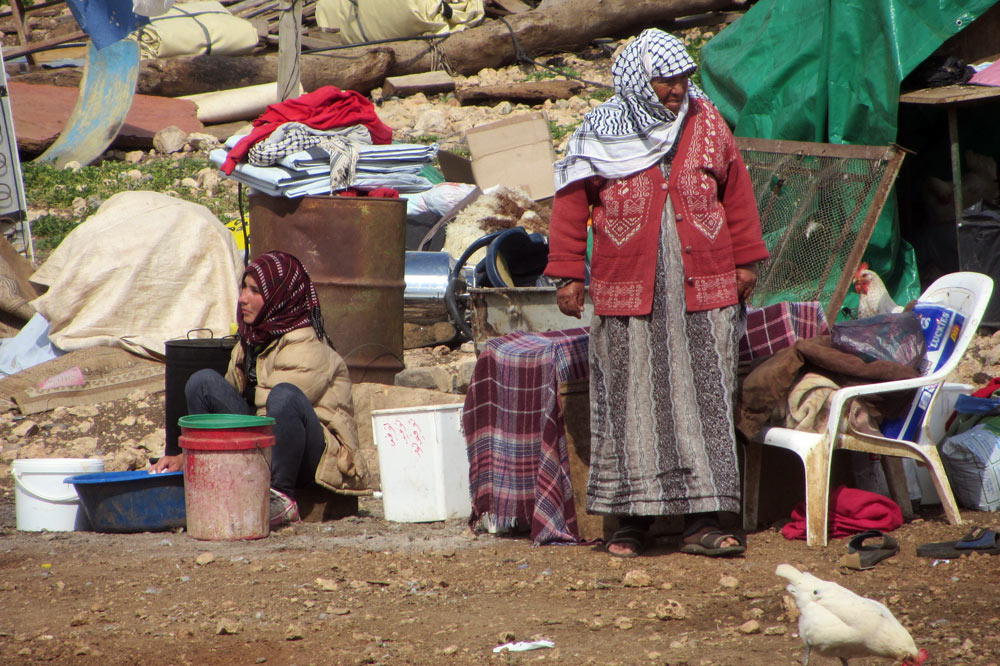

Khallet Makhul residents, two days after the demolition. Photo: ‘Aref Daraghmeh, B’Tselem, 20 March 2015

Suggested items

A resident of Khirbet Homsa al-Fuqa stands amidst the community's property, dumped by Israeli forces near 'Ein a-Shibli. Photo by Oren Ziv, ActiveStills, 7 July 2021

Communities Facing Expulsion

Court sanctioned war crime committed in broad daylight

Yesterday, Israel committed an attempted forcible transfer – a war crime – against residents of Humsah. In a break from the previous five demolitions in the community within less than a year, yesterday, Israeli soldiers and Civil Administration staff removed the contents of some residents’ homes and transported the items to an area located near ‘Ein Shibli, where Israel has been trying to forcibly relocate residents. Israel misrepresented these actions as being part of dialog and consent, proving, if anyone still entertained any doubts, it is intent on expelling these residents from their homes permanently. The military’s response, as it appeared in the media, highlighted the fact that the attempted expulsion was carried out with the approval of Israel’s High Court of Justice. Indeed, when the ICC looks into forcible transfers as part of its investigation of Israel, it will have to assess the responsibility of justices as well as ministers and top military commanders. On Wednesday, at around 8:00 A.M., soldiers and Civil Administration staff arrived at the community of Khirbet Humsah in the northern Jordan Valley. The forces declared the area a closed military zone and denied journalists, human rights activists and diplomats access. The forces dismantled nine tents and four huts used as residences, as well as 17 agricultural structures, all together belonging to nine families with a total of 61 members, including 34 minors. The forces also destroyed four water tanks, water lines, fencing and farming equipment. The residents’ belongings were loaded onto trucks that transported them to the ‘Ein Shibli community, which lies west of Khirbet Humsah. Community members fled to the mountains with their flocks, leaving the buses brought in to forcibly relocate them to ‘Ein Shibli empty.

9 July 2021

Bedouin community in firing zone, near Route 578 (Derech Alon). Photo: Keren Manor / activestills.org, 8 Feb. '11

The Jordan Valley

The Jordan Valley

The Jordan Valley and the northern Dead Sea span some 160,000 hectares, comprising almost 30% of the West Bank. In 2016, approximately 65,000 Palestinians and 11,000 settlers lived there. Almost 90% of this region has been designated Area C, the West Bank land which remains under full Israeli control, and constitutes nearly 40% of all Area C. The remaining 10% of the region is home to Palestinian communities, including the city of Jericho, which have been designated Area A or B. As these communities are surrounded by Area C land, they are cut off from each other. The Jordan Valley is a fertile strip of land that runs along the West Bank, east of the central highlands. Sparsely populated, it has many open, undeveloped areas. As such, this area is the largest land reserve for future development of the West Bank. It could serve to create urban centers; develop advanced agriculture for export; develop energy project and industry. Instead, however, Israel exploits almost all of the Jordan Valley and the northern Dead Sea for its own needs and bars Palestinians from entering or using about 85% of the area: be it for construction, laying infrastructure, shepherding or farming. The legal grounds cited for this sweeping ban vary. So much so that, in some cases, the same land has been given several different designations. Almost 50% of the area are defined as “state land” – more than half of which were already designated as such under Jordanian rule, before Israel occupied the area in 1967; about 46% of area have been declared closed military zones, including the municipal jurisdictions of Israeli settlements and 11 firing zones; some 20% of the area have been declared nature reserves; and other areas have been allocated to settlements’ regional councils. Israel compels Palestinians to remain within the narrow confines of their communities and prevents virtually all Palestinian construction in Area C. The Civil Administration – the branch of the Israeli military designated to handle civil matters in Area C – issues almost no building permits, whatever the purpose: be it for housing, agricultural construction, public buildings or infrastructure. Left with no other choice, Palestinians undertake construction without permits. The CA then issues – and sometimes carries out – demolition orders for these structures. Even when orders are issued but not executed, residents live their lives in a constant state of uncertainty. B’Tselem has monitored demolitions carried out over the years, counting at least 698 Palestinian residential units demolished by the CA in the Jordan Valley from the January 2006 through September 2017. The demolished structures were home to at least 2,948 Palestinians, at least 1,334 of whom were minors. Of these, 783 Palestinians (including 386 minors) had their homes demolished at least twice. From January 2012 to through September 2017, the CA also demolished at least 806 non-residential units, including agricultural structures. The ban on Palestinian construction and development in the Jordan Valley takes a particularly harsh toll on the roughly 10,000 residents of more than 50 Palestinian communities in Area C that Israel is attempting by various means to drive from their homes and land. The authorities deny these communities any possibility whatsoever of lawful construction to meet the needs of their population, and refuse to connect them to water and power supplies. These communities rely on the scant rainfall in the area, which they collect in cisterns and supplement by purchasing water from private vendors who transport water in tankers. Although the water provided by the vendors costs many times as much as the water supplied through the local pipeline, it is often unfit for drinking as it is transported in unsanitary conditions. The residents of these communities use only about 20 liters of water per person a day overall, for all needs. This falls far short of the 100 liters per person per day that is the minimum recommended by the World Health Organization. In recent years, and especially since early 2013, the Israeli military has periodically ordered communities located in areas Israel declared firing zones to temporarily vacate their homes. The official reason given is that the military needs to train in these particular areas, which make up about 45% of the Jordan Valley (73,600 hectares). Time and again, residents have been served military orders requiring them to vacate their homes for various periods of time, ranging from several hours to two whole days. Should they refuse to comply, the orders threaten forced removal, expropriation of their livestock, and retroactive fines covering the costs of the removal. In some cases documented by B’Tselem, notice of the evacuation was only conveyed to the residents verbally, with no written order presented. From January 2013 through September 2017, the military compelled various communities throughout the Jordan Valley to vacate their homes 140 times. Some were subjected to temporary displacement several times, in some cases with only a week’s respite between times. The repeated upheaval has greatly disrupted the lives of these communities. The frequent displacements take a toll on residents’ income and livelihood, and also inspire much fear and uncertainty. Every such removal means leaving homes and property behind and involves expending considerable effort. Families must gather mattresses, blankets and sustenance (food and water) for themselves and for their livestock, before setting out with their children and flocks to seek shelter elsewhere. Sometimes, the flocks cannot be brought along and the residents have no choice but to leave them behind, hoping they will not come to harm. In some instances, families were forced out of their homes in mid-winter and had to seek shelter from the elements in harsh weather. After some removals, residents returned to find their cultivated fields damaged by the military training. Moreover, various Israeli authorities – including the CA, the military and the Israel Nature and Parks Authority – actively harass residents by confiscating essential equipment over and over again. Examples include confiscation of tankers used to transport water, pipelines carrying water from springs, tractors and other farming equipment, and solar panels that provide a bare minimum of electricity. All these measures are adopted with a view to making the residents of Palestinian communities in the Jordan Valley leave their land and homes and to thwart Palestinian development in the region. The overall goal of this policy is to tighten Israel’s grip over the Jordan Valley and further the de-facto annexation of this area to Israel’s sovereign territory, while exploiting its resources. Driving out or expelling residents of an occupied territory from their homes and land is considered forcible transfer of protected persons, which constitutes a war crime. This holds true whether the force used to achieve the transfer is direct or indirect, whether it takes a physical or administrative form, and also whether it achieved through brute force or by creating intolerable living conditions that leave residents no alternative but to leave. All those complicit in committing this crime – including the prime minister, the defense minister, the chief military commander who signs the orders and the judges who lend their seal of approval – bear personal liability for its execution.

18 May 2011

Agriculture

The Hidden Agenda

The report reveals that as far back as the 1970s, Israel planned to annex Ma’ale Adummim. To do this, it expropriated over the years tens of thousands of dunams of Palestinian land and expelled hundreds of Beduin who were living there. Implementation of plans to expand the settlement will destroy north-south territorial contiguity in the West Bank and impede realization of the Palestinians’ right to self-determination.

1 December 2009