
Area C

The village of al-Aqabah

Military training, village of al-‘Aqabah, June 2012.  Photo by ‘Atef Abu a-Rub, B’Tselem, 27 June 2012.
Military training, village of al-‘Aqabah, June 2012. Photo by ‘Atef Abu a-Rub, B’Tselem, 27 June 2012.

The village of al-‘Aqabah has been at its present location in the northern Jordan Valley, about two kilometers east of the village of Tayasir (in Area B) since the early 1900s. Prior to 1967, al-‘Aqabah had a population of about 600, mostly farmers who lived in tents.

After the occupation of the West Bank, a large area – including al-‘Aqabah’s land – was declared a closed military zone. Live-fire military exercises were frequently conducted within the village itself, lasting several days a week, by day and night. The exercises involved the use of tanks, helicopters and guns. During the exercises, the military closed roads and crops were ruined, thereby seriously disrupting the residents’ normal routine and livelihood. Sometimes the exercises even claimed lives. Over the years, two al-‘Aqabah's residents were killed by soldier’s gunfire and four others, including a six-year-old girl, were killed when dud shells left behind after military exercises exploded. At least 38 villagers have been injured by dud shells that exploded after left behind after an exercise. In 1971, the head of the al-‘Aqabah local council was injured by three bullets soldiers fired at him while he was harvesting his fields. He has been wheelchair-bound ever since. In 1999, the Association for Civil Rights in Israel petitioned the High Court of Justice on behalf of the residents, demanding that military exercises in the village and its fields be halted and that the order designating the village a closed military zone be revoked. Following the petition, the Israeli military pledged to conduct no more live-fire exercises in the village and that soldiers would not maneuver among the villagers’ houses.

Sami Subuh, head of al-‘Aqabah Council during military training in the village, June 2012. Subuh, injured at 16 by gunfire during a military exercise, has been wheelchair-bound ever since. Photo by ‘Atef Abu a-Rub, B’Tselem, 27 June 2012.

The villagers, whose number has dwindled over the years to about 230, live in houses built of stone and sheet metal. The Civil Administration has never prepared a master plan for the village and, in early 2004, issued demolition orders for 35 of the village’s 45 buildings, including most of the residential structures, a mosque, a pre-school, a medical clinic, and the community’s only paved road. Residents filed petitions to the High Court of Justice seeking to annul the demolition orders and force the Civil Administration to prepare a master plan that would allow construction in the village. In response to these petitions, the Civil Administration announced in August 2008 that it had marked out an area in the center of the village, where most of the public buildings and fewer than half the residential buildings are located, which it does not intend to demolish “at this time”. That same month, the Court rejected the petition, after finding that rescinding the demolition orders, “would be akin to the Court’s granting a seal of approval to unlawful actions”. Since then, the Civil Administration has demolished several village buildings located outside the marked area, including three residences. In addition, roads that the village council had paved as well as street lighting that the council erected to light the access road to the village were demolished several times by the Civil Administration.
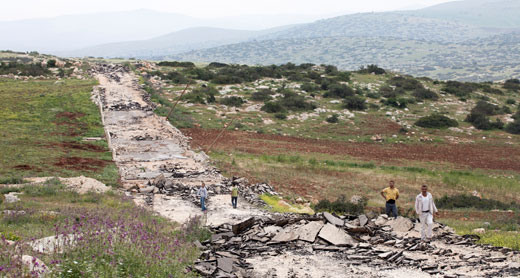
Road razed by Civil Administration, village of al-‘Aqabah, The Jordan Valley.  Photo by Ann Paq, Activestills, 7 April 2011.
Road razed by Civil Administration, village of al-‘Aqabah, The Jordan Valley.  Photo by Ann Paq, Activestills, 7 April 2011.

Since the rejection of their High Court petition, the al-‘Aqabah residents have applied to the Civil Administration a number of times, submitting planning requests and master plan proposals. All were rejected on various grounds. In March 2012, for example, the Civil Administration rejected a master plan proposed by the villagers on the grounds that the area of the plan is inflated in proportion to projected population growth. In its decision, the Civil Administration noted that there is no need to “establish a new planning entity in a firing zone”, when the village of Tayasir is located nearby, in Area B, and its master plan “has not yet fully exhausted its building potential”. The Civil Administration expressed concern that “the main aim of the plan […] is the retroactive approval of illegal construction carried out at that location over the years”. Later, the Civil Administration noted that “because Khirbet al-‘Aqabah” is located in a closed zone (a firing zone), prospects for approval of the plan at this point are poor”. The civil administration refuses to connect the village to the water network, and its residents rely on transporting water in containers from nearby villages.

In July 2012, the Civil Administration issued new demolition orders for several village structures, some of them residential. The residents again petitioned the High Court of Justice seeking to have the orders rescinded, and the Court issued an interim injunction on the demolitions, “subject to a freeze of the status quo on the ground in terms of construction and making use of buildings.” To date, court deliberations on the petition have yet to take place. At the same time, the village council continues to develop the community, aided by international organizations, and in recent years, has built an internal road system, a medical center, a child care center, a sewing workshop and a spice factory.

Suggested items

תושב ח'ירבת חומסה אל-פוקה עומד בתוך רכוש הקהילה שכוחות ישראליים השליכו ליד עין א-שיבלי. צילום: אורן זיו, אקטיבסטילס, 7.7.21

Communities Facing Expulsion

Court sanctioned war crime committed in broad daylight

Yesterday, Israel committed an attempted forcible transfer – a war crime – against residents of Humsah. In a break from the previous five demolitions in the community within less than a year, yesterday, Israeli soldiers and Civil Administration staff removed the contents of some residents’ homes and transported the items to an area located near ‘Ein Shibli, where Israel has been trying to forcibly relocate residents. Israel misrepresented these actions as being part of dialog and consent, proving, if anyone still entertained any doubts, it is intent on expelling these residents from their homes permanently. The military’s response, as it appeared in the media, highlighted the fact that the attempted expulsion was carried out with the approval of Israel’s High Court of Justice. Indeed, when the ICC looks into forcible transfers as part of its investigation of Israel, it will have to assess the responsibility of justices as well as ministers and top military commanders. On Wednesday, at around 8:00 A.M., soldiers and Civil Administration staff arrived at the community of Khirbet Humsah in the northern Jordan Valley. The forces declared the area a closed military zone and denied journalists, human rights activists and diplomats access. The forces dismantled nine tents and four huts used as residences, as well as 17 agricultural structures, all together belonging to nine families with a total of 61 members, including 34 minors. The forces also destroyed four water tanks, water lines, fencing and farming equipment. The residents’ belongings were loaded onto trucks that transported them to the ‘Ein Shibli community, which lies west of Khirbet Humsah. Community members fled to the mountains with their flocks, leaving the buses brought in to forcibly relocate them to ‘Ein Shibli empty.

9 July 2021

Khirbet Humsah residents amidst the ruins of their community. 4 November 2020. Photo by Sarit Michaeli, B'Tslem.

Communities Facing Expulsion

Hagai El-Ad's address at the European Parliament Committee on Human Rights, 16 Nov. 2020

Two weeks ago, on November 3rd, Israel carried out one of its biggest demolition operations in a decade. Khirbet Humsah, an entire Palestinian community in the northern Jordan valley, was demolished within hours. Seventy-four people were left homeless, 41 of them children. Tens of structures, people’s homes and livelihood, were destroyed. Humsah is not alone. For years, Israel has been targeting dozens of Palestinian communities throughout the occupied West Bank. It is a criminal policy of forcible transfer. Israel is turning the lives of these communities into a prolonged nightmare, in order to force them to give up and leave. A nightmare of years of hardship without running water or a connection to the power grid, of home demolitions, of having to repeatedly vacate your home so Israeli troops can train on your land, of ongoing violence by settlers backed by Israeli security forces. And sometimes, all this organized state violence is condensed into a few dark hours, as happened in Humsah. But whether it takes years or mere hours, it is a war crime. The European Union has responded by calling this a “regrettable trend” and saying that “such developments constitute an impediment towards the two-state solution”. Let me be clear: Israel knows, from decades of experience, that the worst it will have to deal with is such inconsequential expressions of concern. Israeli bulldozers on their way to demolish the next home of a defenseless Palestinian are driving on roads paved with such empty rhetoric. Every time euphemisms are used instead of calling crimes by their proper name, it emboldens Israel to continue its policies of oppression, dispossession, and violence against Palestinians. International acquiescence, decorated by meaningless talk of a “two-state solution”, is the backbone of the inherently undemocratic one-state reality we live in. Everyone knows – in European capitals and in this parliament – that more statements will not stop the next demolition. When the lines have nothing in them, Israel doesn’t even have to read between them to recognize a green light to continue oppressing Palestinians. Without real consequences, that green light will continue to shine. Humsah was not the first. And as long as impunity is the norm, it will not be the last. Everywhere in the Jordan valley, Palestinian communities face similar predicaments, while at the same time Israel established more and more settlement points. In Jerusalem, Palestinian families are forced out of their homes so Jewish settlers can move in. A few kilometers to the east, the community of Khan al-Ahmar is awaiting its turn. In the South Hebron Hills, Palestinian communities fear, after struggling for 20 years to stay on their land, the forthcoming ruling by Israel’s High Court of Justice. A court so just that it has never ruled against Israel’s Kafkaesque planning regime in the West Bank – a regime tailored to forbidding Palestinian development while issuing permits to build and expand Israeli settlements. By legitimizing all this, Israel’s highest court functions as a key enabler of flagrantly illegal policies meant to forcibly transfer Palestinians. All this has been happening for decades, and continues also after Israel recently set aside – at least for the time being – its plan to formally annex parts of the West Bank. De-jure or de-facto, the formal status of Palestinian land has never stopped Israel from promoting its interests at the expense of Palestinians’ rights. Clearly, if Israel cared about international law or respecting human rights, it would not have built more than 250 settlements in which some 600,000 Israelis already live. Does Europe really need an announcement of de-jure annexation to see reality for what it is? How many years of prolonged occupation, how many explicit statements by Israeli leaders, how many infrastructure projects, how many settlers does it take for Europe to wake up to the reality of Israel’s permanent control of everything and everyone between the Jordan river and the Mediterranean sea? A century of occupation? A million settlers? What is it that the EU is waiting for? Consequences for human rights violations can be introduced through European foreign policy, by effectively using Europe’s considerable leverage. Clearly, the decision to not do so is a political choice. It undermines Europe’s commitment to human rights and weakens the rules-based international order. It normalizes oppression and dehumanizes Palestinians, because – apparently – no one has to be held accountable for their permanent subjugation. Not when an entire community is razed to the ground, not when hundreds of demonstrators are shot with live bullets along the Gaza fence, not when dozens of families were wiped out in their own homes in the massive attack on Gaza in 2014. Not now, not ever. Europe has international responsibilities. It is the most significant international stakeholder committed, at its core, to democracy and to the rule of law. Grave, systemic human rights violations have been going on for years, in broad daylight, in Europe’s neighborhood. Put the empty rhetoric aside. See reality for what it is. Stand up for the universal values enshrined in law in the aftermath of the Second World War. Protect the rights of Palestinians. The time is now.

16 November 2020

Alan Dagharmeh and members of his family, residents of al-Farsiya, with the remains of their property. Photo: ‘Atef Abu a-Rub, B'Tselem, 10 August 2010. 

The Jordan Valley

The village of al-Farisiyah – demolitions for alleged construction in firing zone

Al-Farisiyah, a village in the northern Jordan Valley that existed since before Israel occupied the West Bank in 1967, and was completely demolished by Israel in 2010: The community currently comprises five compounds. About 300 people live in the community year-round, and another 200 live there only in winter. All the residents live in tents or shacks and earn their living as shepherds and farmers. The compounds of the communities compounds are not connected to the power or water grids; and average water consumption is just 20 liters a day, far short of the World Health Organization’s recommended minimum of 100 liters per person per day. There are no schools in al-Farisiya, so the children must walk about five kilometers every day to reach school in the village of ‘Ein al-Beida. There are two schools in ‘Ein al-Baida, one for boys and one for girls, each combining an elementary school and a high school. Settlements and settlement outposts completely surround the community: Giv’at Sal’it and Mehola to the north of al-Farisiyah; Shadmot Mehola and Rotem to the east; and Maskiyyot to the south. The military has also declared the village and extensive areas to its south, north, and west as a firing zone. Other nearby land has been declared part of the jurisdiction or municipal area of nearby settlements. Israel uses these designations to completely block off access by al-Farisiyah residents to most of the surrounding land, where they have grazed their flocks for years.

6 January 2014