Restrictions on Movement

Israeli military imposes 2½-week collective punishment on ‘Azzun’s 10,000 residents for actions by individuals

Image
Taxi waiting for passengers outside the closed gate at the main entrance to ‘Azzun. Photo by Abdulkarim Sadi, B’Tselem, 2 Feb. 2017

In late January 2017, the military blocked off vehicle access via the main entrance of Palestinian village of ‘Azzun - and kept the entrance shut nearly continuously for two and a half weeks - as collective punishment for incidents in which stones and Molotov cocktails were hurled and live ammunition fired at the major traffic artery that runs close to the village. ‘Azzun, which is home to some 10,000 people, lies east of the town of Qalqiliya, close to Route 55 that links the town with Nablus and serves as the main road in the area. As B’Tselem has reported, the eastern entrance to ‘Azzun, which is close to the settlements of Maale Shomron and Karnei Shomron, was blocked off by the military as far back as 1990. Since then, residents have used the three remaining entrances to the village: the north entrance, which is the main entrance and leads into Route 55, the north-western one, and the southern one. In 2016 the military closed the main entrance six times, for several hours each time.

Taxi waiting for passengers outside the closed gate at the main entrance to ‘Azzun. Photo by Abdulkarim Sadi, B’Tselem, 2 Feb. 2017
Taxi waiting for passengers outside the closed gate at the main entrance to ‘Azzun. Photo by Abdulkarim Sadi, B’Tselem, 2 Feb. 2017 

On the afternoon of Thursday, 26 January 2017, the military closed the gate at the main entrance to the village and posted soldiers there to keep vehicles from getting through. The military also closed the gate at the north-western entrance, which leads to the neighboring village of ‘Izbat a-Tabib, and placed a checkpoint at the southern entrance, which leads to the village of Thulath. In addition, the military placed dirt piles to block off access to a tunnel that runs under Route 55, which residents of the village use to reach their farmland that lies north of the road. Youths from the village cleared away the dirt piles after a few days, enabling residents to use the tunnel again. Until then, the quickest way to access Route 55 was to drive along dirt roads that link ‘Azzun with the nearby village of ‘Asleh, and from there to ‘Izbat a-Tabib, which lies on Route 55.

Map: ‘Azzun and its environs

During the weeks that the main entrance was closed, the soldiers opened it at random times for several hours a time, without giving residents prior notice. Young men from the village opened the gate twice when soldiers were off duty, but the military closed it again.

Blocking the main entrance to ‘Azzun also affected the 6,000 or so residents of villages to the south of ‘Azzun, as they need to drive through ‘Azzun to reach Route 55. Whenever the military closes off the ‘Azzun access point, these residents also have to take circuitous routes.

The restrictions the military imposed on the freedom of movement of all Palestinians living in the area make daily life difficult for tens of thousands of people, including the workforce, students, merchants, and ill people – all residents of Area B. These repercussions demonstrate once again how Israel continues to control the lives of all Palestinians in the West Bank, not only those who live in areas designated Area C.

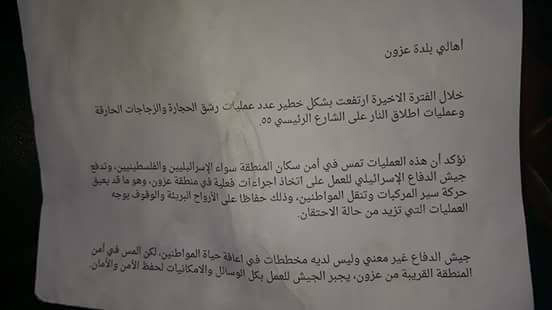
On 5 February, about ten days after the entrances to ‘Azzun were closed, soldiers handed out pamphlets to pedestrians crossing the checkpoint. The text, written in Arabic, reads as follows:

Residents of ‘Azzun: There has recently been a dangerous upsurge in incidents targeting Route 55 that involved throwing stones and Molotov cocktails, and gunfire. We declare that these attacks endanger the safety of Israeli and Palestinian residents of the area, and oblige the IDF to take essential measures in the area of ‘Azzun that may disrupt vehicular traffic and travel by residents, in order to protect the lives of innocent residents and respond to the violent incidents (attacks) that have caused an escalation. The IDF does not wish to disrupt the lives of the residents and does not plan to do so. However, due to the compromised security near ‘Azzun, the IDF is obliged to take all necessary measures to maintain security and safety.

Closing off roads as a response to instance of throwing stones and Molotov cocktails or gunfire is unlawful and constitutes collective punishment of the residents of ‘Azzun and of nearby villages. Collective punishment is prohibited under Article 33 of the Fourth Geneva Convention, which states that persons must not be punished for offenses that they did not commit. The military’s argument that this is an exceptional situation that obliges it – against its wishes – to restrict residents’ freedom of movement is baseless. First, blocking traffic has nothing to do with preventing gunfire or the throwing of stones and Molotov cocktails; it is designed to pressure residents into taking action within the community to stop these incidents. Second, these restrictions are far from unusual, as the military has been employing them for many years throughout the West Bank as part of its declared policy.

Suggested items

Roadblock placed by the military at the entrance to Beita. Photo: Salma a-Deb’i, B'Tselem, 4 September 2016

Economic & Social Rights

Israel imposes traffic restrictions in southern Nablus District, disrupting lives of over 54,000 Palestinians

From 4 to 11 September 2016, the military blocked the entrances to ten Palestinian communities in the south of Nablus District, along the Huwara road. The military also blocked several roads used to access farmland and side roads. This came on top of the regular closure of the main entrance to 'Awarta, imposed by the military since the killing of Eitam and Naama Henkin in a terror attack in October 2015. These restrictions disrupted the lives of some 54,000 residents in the area. The Israeli authorities informed the Palestinian DCO that the reason for the roadblocks was the throwing of a Molotov cocktail at an Israeli vehicle in the area. The restrictions were removed as part of the “relaxations” agreed by Israel to mark the Muslim festival of ‘Eid al-Adha. However, a few days later, on 20 September, the restrictions were reinstated, and side roads and dirt tracks that had been used as an alternative to the main roads two weeks earlier were also blocked. The Palestinian DCO notified the heads of the local Palestinian councils that the second closure followed the throwing of stones at an Israeli bus near Huwara. The restrictions were removed on 26 September. The Palestinian communities to which access was blocked were defined in the Oslo Accords as Area B, which is under the administrative responsibility of the Palestinian Authority. These are small communities whose residents depend on the regional center – Nablus – for their routine needs. Many of them work or study in the city and receive various services there, including healthcare. The restrictions forced the residents to use roundabout and even dangerous routes. Ambulances traveled along uneven surfaces; patients and elderly people were forced to walk long distances by foot; teachers were delayed on their way to school; physicians missed scheduled appointments with patients; and women, men, and children had to wait for taxis willing to take the roundabout routes. These traffic restrictions lengthened the time needed to travel to Nablus and other communities in the district by 20 to 40 minutes, and also caused a hike in transportation costs. Public transportation in the area is based mainly on shared taxis, and the cost of a journey between Nablus and most of the communities in the area is usually in the range of NIS 5-10 (USD 1.5-2.5). Following the road closures, many of the shared taxis stopped operating and residents were forced to use private taxis at a significantly higher cost. The restrictions, imposed without any prior warning, created a state of uncertainty among all the residents of the area, who had no way of knowing which roads had been closed, how long it would take them to reach their destination, and when the military planned to remove the restrictions. This action constituted the collective punishment of tens of thousands of people. It also refutes Israel’s claim that large sections of the West Bank have been transferred to the control of the Palestinian Authority and that it does not manage these areas. As this affair shows, Israel can all too easily disrupt the lives of tens of thousands of Palestinians, while the Palestinian Authority has no ability to influence or intervene in these actions. On 21-22 September 2016, Salma a-Deb’i, B'Tselem’s field researcher in the Nablus area, collected testimonies from residents of the area, who described the difficulties they faced due to the restrictions: Roadblock placed by the military at the entrance to ‘Einabus. Photo: Salma a-Deb’i, B'Tselem, 4 September 2016 Fawzeyeh ‘Ata ‘Ali Qawariq, diabetic patient, 62, resident of ‘Awarta, stated in her testimony: On Tuesday, 20 September 2016, at about three o’clock at night, my daughter Su’ad told me that they had blocked the entrance to our town, and to several other villages in the area, with dirt piles. I became anxious when I heard this, because I have diabetes and I had an appointment at the medical clinic scheduled for that day. It’s a monthly appointment that I must keep, because I have to undergo tests and get new prescriptions for medicines. I left home at eight in the morning and got on a shared taxi. It took a roundabout route along a farmers’ road through Huwara Valley, and the journey was very slow. It took us half an hour to get from Huwara to Odala, a trip that usually takes ten minutes. When I got to the clinic, the nurse took my blood pressure as usual and told me that it was high. I told her that I had been anxious because of the closure of the road and had been sitting since dawn wondering how I would get to the clinic. I took the medication and went home by the same difficult route. I couldn’t understand why they were doing this to us. I’m very worried about the situation, because my husband also needs to go to Nablus several times a week for treatment. He has a number of medical problems, including a heart problem and urinary failure, and traveling along these roads is very difficult for him. The restrictions also harm my sons, who work in Israel and in Huwara and have to struggle along these roads to get to their places of work. If they arrive late it causes problems with their work. No-one here can understand why they are closing the roads. Where do they want us to go? They ignore the fact that people live here and need to go places for their daily needs – for our livelihood, health, and our very existence. Roadblock placed by the military at the entrance to Odala. Photo: Salma a-Deb’i, B'Tselem, 4 September 2016 Dalal Mahmud Hassan Faqha , 43, science teacher and resident of Deir Sharaf, described her difficulties reaching work: I am a science teacher at a co-ed school in Burin. I usually travel to Nablus in the morning, and then continue on to the school with my colleagues. Because of the restrictions, we had to leave half an hour early and try to travel through the villages of Tell and Madama, since we were afraid that the entrance to Burin was blocked. We have suffered from traffic restrictions since 2000. Every time they set up roadblocks, impose restrictions, and close roads. Because I have to leave early in the morning, I don’t have time to make breakfast for my children or spend time with them. I get up at 5:50 A.M. and leave home quickly in order to get to Nablus and then to my workplace in Burin. All the way I am nervous and afraid that I won’t manage to meet my colleagues in Nablus and join the ride. When that happens, I have to take a taxi, and when restrictions are imposed it’s very difficult to find a place in a taxi. Feeling that your movement is limited is very disturbing. You don’t know how you will get to work or back home. I’m not interested any more in the reasons for the road closures. No one talks about that. They only talk about how to cope with the situation, get to work, make a living, and get back home. It doesn’t serve any goal other than punishing and humiliating us for no reason. Roadblock placed by the military at the entrance to Beita. Photo: Salma a-Deb’i, B'Tselem, 4 September 2016 Yusef Musa Muhammad Diriyah, 40, ambulance driver and resident of ‘Aqraba, described how the restrictions endanger patients’ lives: I am an ambulance driver at the trauma center in ‘Aqraba. The old eastern entrance to the village (the ‘Aqraba-‘Awarta road) has been closed since 2000. Now, since the restrictions were imposed, the main entrance to the town is also closed. The road through Beita can’t be used either, because the entrance to Beita is blocked. Since the restrictions were imposed at the beginning of the month, the only way to our town is through Osarin. This is a difficult and winding road and even in emergencies we cannot drive fast, because it’s really dangerous. We are responsible not only for the ‘Aqraba area, but also for trauma cases, diseases, and road accidents throughout the southern part of Nablus District. There are a lot of wild boars in the southern Nablus area, and this causes road accidents. Using this road delays our work and exposes us, our patients, and other passengers along the way to danger. The only alternative to Osarin is the road through Majdal Bani Fadel, in the opposite direction. It feels as if we and the whole area are under siege. Before ‘Eid al-Adha, when the roads were closed, the Red Crescent station in Nablus sent me to pick up a patient in the village of Beita. I drove along the Beita-‘Aqraba road and reached the patient, who was showing symptoms of a stroke. I evacuated him in the ambulance up to the earth barrier at the main entrance to Beita, and waited there for a Red Crescent ambulance. They transferred the patient from to their ambulance on a stretcher. If this had been a situation requiring an urgent response, such as a road accident or fire, we would really have had a problem.

30 October 2016