Dear Friends, 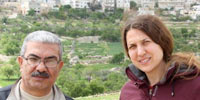
The report team: Naama Baumgarten-Sharon, author of the report, and Iyad Hadad, B’Tselem field researcher in Ramallah District. | |
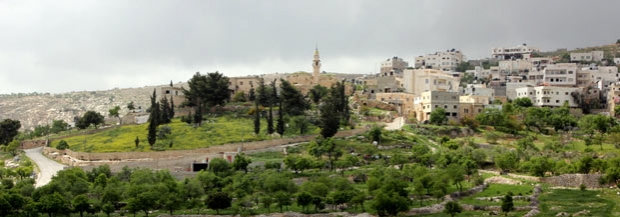
For 47 years, Palestinians in the West Bank have lived without liberty, under ongoing occupation. The impact of the human rights violations involved in this reality on the daily lives of Palestinians often goes unnoticed, with coverage focusing on cases of killing or substantial demolition. It is the gradual, creeping impact of the occupation that we present in our new report on the village of Burqah: B’Tselem’s first comprehensive attempt to examine the occupation’s effect on the development of a single Palestinian village. Accordingly, the report examines aspects of routine daily life in the village: residents’ restricted freedom of movement ever since the military closed off the roads to the village, essentially isolating it and cutting residents off from the city of Ramallah, the nearby major urban center; the grim economic situation in the village, due in part to diminished farming – the traditional mainstay of most village families – after many village lands were taken over for the establishment of Israeli settlements; and a housing shortage caused by the Civil Administration policy not to issue building permits to Palestinians. Burqah is a case in point, illustrating the reality suffered in many villages in the West Bank, under an occupation that is rapidly approaching its fiftieth year. Sincerely, Naama Baumgarten-Sharon Author of the report | | |  In response to reports that Israeli Minster of Defense Moshe Ya’alon intends to yield to the settler demand to prevent Palestinian day laborers from returning home to the West Bank on Israeli public buses, Israeli human rights group B'Tselem says that Minister Ya'alon is not content with merely moving Palestinians to the back of the bus, but means to keep them off buses altogether. It is time to stop hiding behind technical arrangements such as the demand that Palestinians return to the West Bank through the same checkpoint they entered Israel, and admit this military procedure is thinly veiled pandering to the demand for racial segregation on buses. | | READ MORE >> | | | 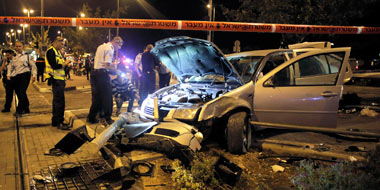 B'Tselem sends deep condolences to the families of 3-month-old Haya Zissel-Brown and Karen Yemima Muskara, 20, who were killed in a run-over attack by a Palestinian driver in Jerusalem on 22 Oct., and wishes a speedy recovery to the persons injured in the attack. We condemn any and all intentional harm to Israeli and Palestinian civilians and call upon politicians and leaders on both sides to act responsibly and avoid fanning the flames of violence. | | READ MORE >> | | | 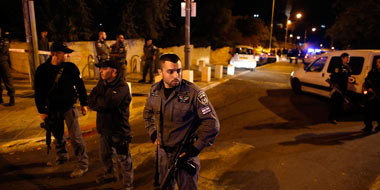 B'Tselem is shocked and concerned over the attempt made on Oct. 29 to assassinate Israeli right-wing activist Yehuda Glick in Jerusalem, and hopes that he will regain full health. B'Tselem urges the police, the Jerusalem Municipality and Israeli and Palestinian public leaders to act responsibly and safeguard the well-being and human rights of all residents in East Jerusalem and West Jerusalem. | | READ MORE >> | | | 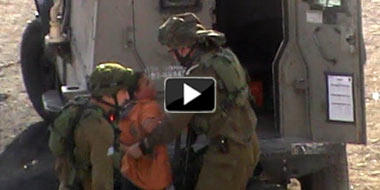 On Oct. 18, soldiers briefly detained a developmentally disabled Palestinian boy, who is under the age of criminal responsibility, on suspicion that he had thrown stones. The boy, A. a-Rajbi, (full name withheld in interest of privacy) who will be 12 in a month, was detained after Palestinian children threw stones at soldiers on the main road of the Jabel Johar neighborhood in Hebron, close to the settlement of Kiryat Arba. A-Rajbi was handcuffed, blindfolded, and held on the floor of an army jeep for some 15 minutes until his father arrived and convinced the soldiers to release his son, who is mentally disabled and cannot speak. | | READ MORE >> | | | 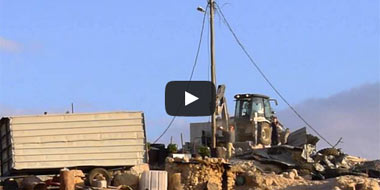 On 29 Sept. 2014, Civil Administration representatives sawed down dozens of electricity poles and cut the wires in Khirbet a-Twayel, one of dozens of shepherding communities in the Jordan Valley currently under threat of expulsion. The community’s 113 permanent residents, including 62 children, and another 100 or so seasonal residents have lived at the site for decades. Most of their structures were built before 1967. Their power grid was demolished as part of ongoing efforts to expel dozens of Palestinian shepherding communities from Area C and take over their land. | | READ MORE >> | |
| |