Dear Friends,
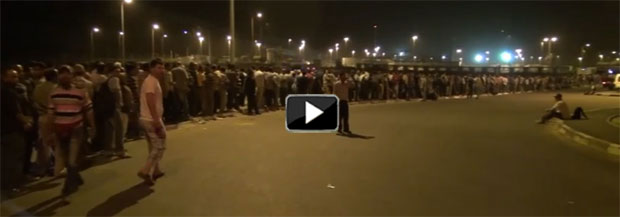
 Several B’Tselem staff members recently visited and filmed two checkpoints in the West Bank that serve as crossing points into Israel for Palestinians with work permits. More than 30,000 Palestinians currently have permits to work in Israel and may enter the country through any one of eleven checkpoints. The two checkpoints we visited are run by private security companies hired by the Ministry of Defense. Several B’Tselem staff members recently visited and filmed two checkpoints in the West Bank that serve as crossing points into Israel for Palestinians with work permits. More than 30,000 Palestinians currently have permits to work in Israel and may enter the country through any one of eleven checkpoints. The two checkpoints we visited are run by private security companies hired by the Ministry of Defense. We encountered a harsh reality, whereby hardworking laborers are forced to forgo a night’s sleep and wait hours on end until the checkpoints open just so they can provide for their families and reach work on time. This situation is not the result of a force majeure but of decisions made by the Ministry of Defense. The long, exhausting wait for the checkpoints to open is nothing new – six years ago, in 2007, B’Tselem already filmed similar images at those very checkpoints. In its response to a feature story about Tarqumya Checkpoint that was broadcast on Israel’s Channel Two News, the Ministry of Defense stated that it is adopting measures to improve conditions at the checkpoints. B’Tselem wrote to the Ministry of Defense, asking about the nature of the proposed improvements and when they are scheduled to be implemented. Israel is duty-bound to ensure that people who have permission to enter the country to work can do so under humane conditions that accord them respect, not humiliation. Sincerely, Suhair ‘Abdi Data Coordinator |
|
|
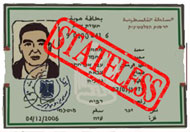 40,000 to 50,000 individuals currently live in the Gaza Strip without ID cards recognized by Israel, nor do they have any official status elsewhere in the world. Some of them were born in the Gaza Strip but were never recognized as residents by Israel: some fled the Gaza Strip during the 1967 war, or left Gaza for various reasons after 1967 and later returned. A small number were born in the Gaza Strip and have never left it, but do not have ID cards for various reasons. Israel, which still controls the Palestinian Population Registry, must allow all stateless individuals in Gaza to obtain status. |
| READ MORE >> |
|
|
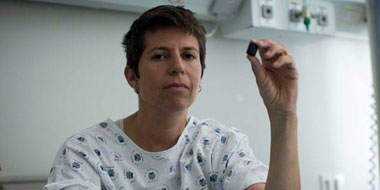 On 19 July 2013 B’Tselem Spokesperson Sarit Michaeli was hit and injured by a rubber-coated metal bullet a Border Police officer fired at her while she was filming a demonstration at the village of a-Nabi Saleh. The shooting contravenes military directives. B’Tselem will convey documentation of the incident to police. |
| READ MORE >> |
|
|
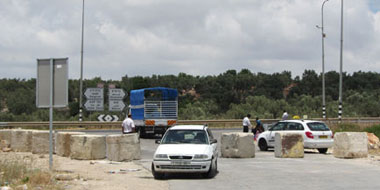 The military routinely blocks the main entrance to the village of 'Azzun from Road 55 for a few hours to a few days at a time in response to stone and Molotov cocktail throwing in its vicinity. Blocking the road due to stone throwing is prohibited collective punishment of the village residents. The military must counteract stone and Molotov cocktail throwing using the lawful means at its disposal. |
| READ MORE >> |
|
|
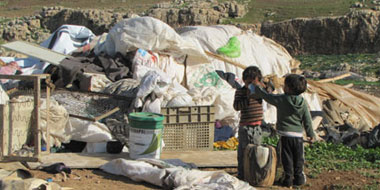 In response to the report of Israel's State Comptroller on law enforcement issues in the West Bank, B'Tselem said the report added another layer to the understanding that Israel's entire law enforcement system in the West Bank is enslaved to the settlement project, and that the failings detailed are a direct result of the policy of successive Israeli governments. |
| READ MORE >> |
|
|
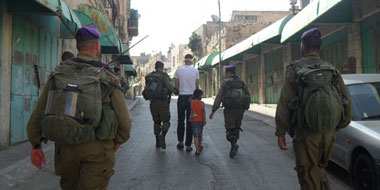 This month, B'Tselem documented a serious incident in which soldiers detained a five-year-old boy in Hebron for two hours, after he threw a stone. The Legal Adviser in the West Bank stated in response that he does not find fault with the soldiers' conduct. The video footage was widely publicized and garnered many responses, including one by Maariv commentator Ben-Dror Yemini, who attacked B'Tselem for not publishing the event's context. Spokesperson Sarit Michaeli responded in an article published in Maariv. This month, B'Tselem documented a serious incident in which soldiers detained a five-year-old boy in Hebron for two hours, after he threw a stone. The Legal Adviser in the West Bank stated in response that he does not find fault with the soldiers' conduct. The video footage was widely publicized and garnered many responses, including one by Maariv commentator Ben-Dror Yemini, who attacked B'Tselem for not publishing the event's context. Spokesperson Sarit Michaeli responded in an article published in Maariv. |
| READ MORE >> |
|
|
 Action on Armed Violence has selected B'Tselem's Executive Director Jessica Montell as one of 100 people working to make the world a safer place. The organization, dedicated to reducing armed violence around the world has compiled a list of "100 people who are outstanding examples of those trying to change the world for the better." The list includes government officials, international legal figures, academics, journalists, donors, public figures and non-for-profit. |
| READ MORE >> |
|