Dear friends,
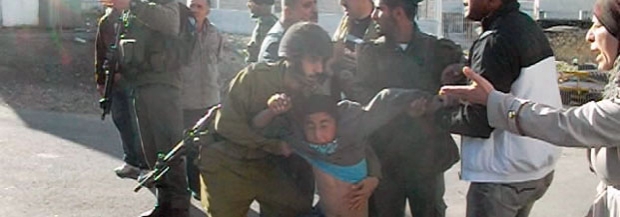
 Jessica MontellEach year at Passover, Jews recite "In every generation we are commanded to see ourselves as if we personally went forth from Egypt." This feeling that we went from slavery to freedom is very powerful. Its meaning extends beyond understanding and identification with a scenario of going from darkness to light. It includes an appeal to make things right. For me, inherent in the Passover ritual is also the understanding that it is not only the marking of a historic event, but also a time to examine the present through the lens of oppression and freedom. For people in Israel it means seeing that in our immediate surroundings there are people who are not free to determine their own fate, living behind checkpoints and walls, unable to support their families or to protect them from violence. Just yesterday we documented a mass detention of Palestinian minors in Hebron without respect for their rights. Passover is not only a commemoration of the past, it is also an opportunity to promote freedom in our own time. Jessica MontellEach year at Passover, Jews recite "In every generation we are commanded to see ourselves as if we personally went forth from Egypt." This feeling that we went from slavery to freedom is very powerful. Its meaning extends beyond understanding and identification with a scenario of going from darkness to light. It includes an appeal to make things right. For me, inherent in the Passover ritual is also the understanding that it is not only the marking of a historic event, but also a time to examine the present through the lens of oppression and freedom. For people in Israel it means seeing that in our immediate surroundings there are people who are not free to determine their own fate, living behind checkpoints and walls, unable to support their families or to protect them from violence. Just yesterday we documented a mass detention of Palestinian minors in Hebron without respect for their rights. Passover is not only a commemoration of the past, it is also an opportunity to promote freedom in our own time.
I send my very best wishes for Passover and Easter to all celebrating these holidays. Jessica Montell Executive Director | | | On the morning of 20 March 2013, the Israeli military detained nearly 30 Palestinian minors on their way to school in Hebron, many of whom were under the age of criminal responsibility (12). Later that day, B’Tselem wrote to the Legal Advisor in Judea and Samaria, the Legal Advisor of the Israel Police and to the spokesperson for the Judea and Samaria Division regarding this issue. The officials confirmed that, further to a stone-throwing incident earlier that morning, the military apprehended 27 minors, including at least 14 under the age of 12. Later, the military released 20 of the minors to the custody of the Palestinian Authority. The other seven minors were questioned by the police. B’Tselem stressed the following: minors should not be questioned without their parents’ knowledge and the presence of an adult representative on their behalf; the police is duty-bound to inform parents immediately upon the detention of their children; it is unlawful to detain or transport minors under the age of 12. | | READ MORE >> | | | 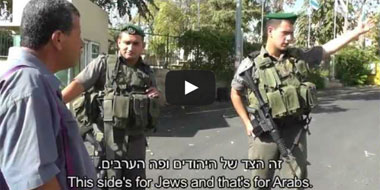 Since 1994, when settler Baruch Goldstein massacred Moslem worshipers in the Tomb of the Patriarchs, the Israeli military has employed a "policy of separation" in Hebron. This is implemented primarily through severe restrictions on Palestinian movement in downtown Hebron, where most Israeli settlement outposts are located. Lately, the military has further entrenched this policy by building a fence that divides a central street lengthwise and allowing only Jews to use the paved side of the street while Palestinians must use a rough, unpaved passageway. | | READ MORE >> | | | 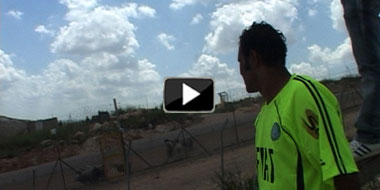 The mother of a resident of the village of Bil’in who was killed by a tear-gas grenade fired at him by a soldier has petitioned the High Court of Justice. The petition demands that the Military Advocate General, Major-General Danny Efroni, be ordered to reach a decision in the case and prosecute the soldier who fired the grenade and all those bearing command responsibility for the killing of her son. In the petition, which was filed jointly with Bil’in Village Council, B’Tselem and Yesh Din, Subhiya Abu Rahmah demands an urgent hearing in view of the fact that almost four years have passed since her son was killed. The incident was documented in the film Five Broken Cameras, which was a candidate for the 2013 Academy Awards. | | READ MORE >> | | | 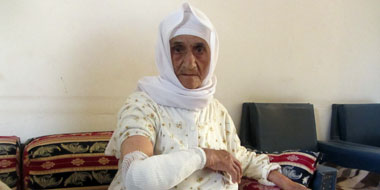 In January 2013, B'Tselem documented two extremely worrying cases of Israeli military dogs assaulting Palestinian civilians, one in the city of Jenin and the other in the village of Tamun. In both cases, dogs attacked civilians in or near their homes. The dogs were in the company of military forces that entered residential areas. In one case, an 88-year-old woman from Jenin was assaulted inside her home and had to undergo several operations for her injuries. B'Tselem reported these cases to OC Judea and Samaria Division and demanded that the use of dogs in residential areas of the West Bank be prohibited. | | READ MORE >> | | | 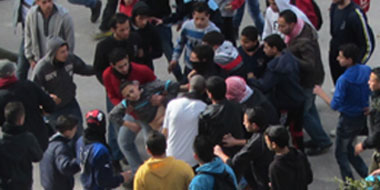 Following the death of Muhammad ‘Asfur on 3 March from injuries sustained two weeks earlier, Israeli human rights group B’Tselem wrote to Military Advocate General Major-General Danny Efroni, repeating its demand that cases of severe injury to Palestinians by soldiers’ fire be immediately investigated. On 5 March 2013, B’Tselem sent the MAG a list of five incidents in which Palestinians were injured recently by soldiers, including the case of ‘Asfur, who was shot in the head with a rubber-coated metal bullet. | | READ MORE >> | | | 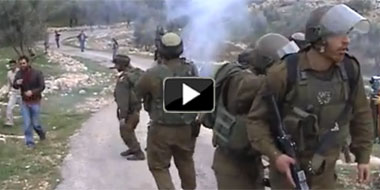 On 3 March 2013, B’Tselem filed an appeal against the decision of the MAG Corps not to indict in the case of Eran Cohen, an Israel civilian injured by a rubber-coated metal bullet during a demonstration in Bil’in on 14 March 2008. Cohen was shot by an Israeli officer despite having done nothing to endanger the soldiers, as can be seen in two separate videos of the incident that were conveyed to the police. The MAG Corps refused to disclose to B’Tselem its reasoning for closing the case. | | READ MORE >> | |
| |